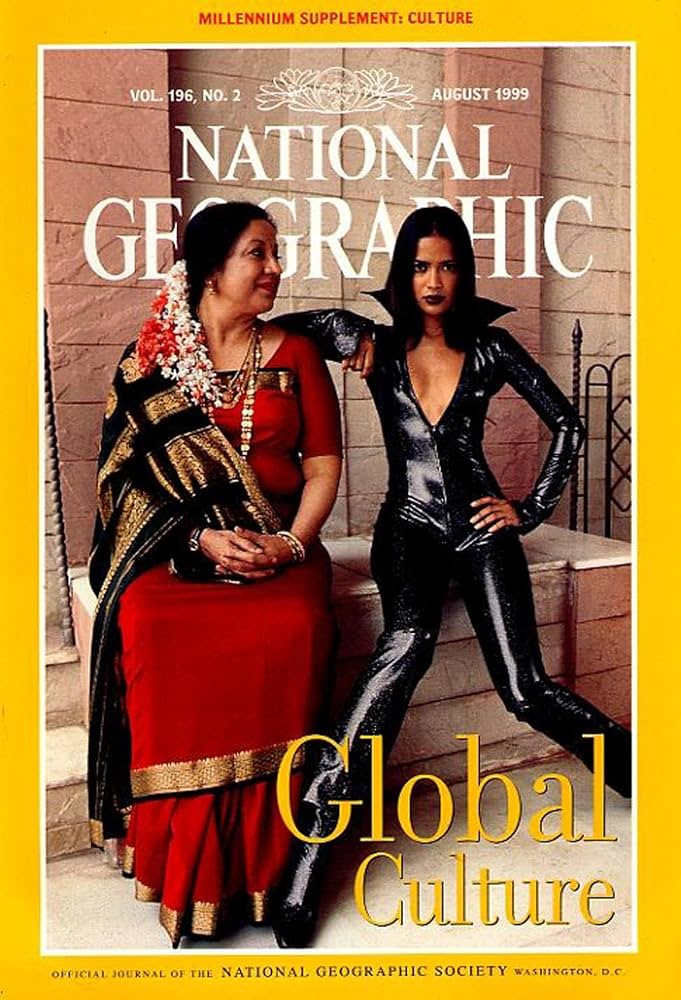
This is the final two pages of an article that appeared in the edition of National Geographic from August, 1999. It is volume 196 no. 2 entitled Global Cultures. The article is titled A World Together.
"A group of boys squeezed past. One of them was wearing a T-shirt emblazoned “Titanic.” I had to know why. He grinned shyly. Had he seen the movie? “No,” he replied. Did he know the story? “Not really,” he said. “But my friend told me about it.
But why, I wondered, would a boy want to wear a T-shirt advertising something he knew nothing about, that represented no experience he’d ever had, that referred to nothing that mattered to him? The shirt, it occurred to me, didn’t link him to the movie (or that damn song) or even to the West at large. But it did link him to his friend.
Linking: This is what the spread of global culture ultimately means. Good will continue to move-from 1987 to 1996 local economies in California exported 200 percent more products, businesses in Idaho 375 percent more. People move: it’s cheaper for businesses to import talented employees then to train people at home. Ideas move: In Japan a generation of children raised with interactive computer games has sensed, at least at the cyber level, new possibilities. “What this exposure has given them is a direct sense . . . of asking the ‘what if’ questions they could never comfortably ask before (because of the Shinto superstition that saying a thing would make it happen),” wrote Kenichi Ohmae in The End of the Nation State. “The implicit message in all this. . . is that it is possible to actively take control of one’s situation or circumstances and, thereby, to change one’s fate. . . For the Japanese, this is an entirely new way of thinking.
Change: It’s a reality, not a choice. But what will be it’s true driving force? Cultures don’t become more uniform; instead, both old and new tend to transform each other. The late philosopher Isaiah Berlin believed that, rather then aspire to some utopian ideal, a sociert should strive for something else: “not that we agree with each other,” his biographer explained, “but that we can understand each other.”
In Shanghai once October evening I joined a group gathered in a small, sterile hotel meeting room. It was the eve of Yom Kippur, the Jewish Day of Atonement, and there were diplomats, teachers, and businessmen from many Western countries. Elegant woman with lively children, single men, young fathers. Shalom Greenberg, a young Jew from Israel married to an American, was presiding over his first High Holy Days as rabbi of the infant congregation.
“It’s part of Jewish history that Jews went all over the world,” Rabbi Greenberg reflected. “They received a lot from local cultures, but they also kept their own identity.”
The solemn liturgy proceeded, unchanged over thousands of years and hundreds of alien cultures: “Create in me a clean heart, O God, and renew a right spirit within me,” he intoned. I’m neither Jewish nor Chinese, but sitting here I don’t feel foreign – I felt at home. The penitence may have been Jewish, but the aspiration was universal.
Global culture doesn’t mean just more TV sets and Nike shoes. Linking is humanity’s natural impulse, it’s common destiny. But the ties that bind people around the world are not merely technological or commercial. They are powerful cords of the heart."